Mechanical Behaviour and Microstructural Analysis of Copper Parts Fabricated by the ADAM Process
Armstrong, Mark, Ahmad Mehrabi, Hamid, Naveed, Nida and Ridley, Glenn
(2025)
Mechanical Behaviour and Microstructural Analysis of Copper Parts Fabricated by the ADAM Process.
In: International Symposium on Smart Energy, Materials, Manufacturing and Digital Technologies (ISSMART 2025), 01 Dec 2025, Teesside University.
| Item Type: |
Conference or Workshop Item
(Poster)
|
Abstract
This study examines the mechanical behaviour and microstructural features of copper parts fabricated using Atomic Diffusion Additive Manufacturing (ADAM). Copper is industrially important owing to its high conductivity, yet it presents challenges in metal additive manufacturing (AM) due to its reflectivity and oxidation. Independent evaluation of ADAM-fabricated components provides a valuable baseline for understanding its potential and limitations.
Tensile specimens were printed, debound, and sintered under standard process parameters. Five replicates were tested under uniaxial loading, with results reported as mean values ± standard deviation (n = 5). The average 0.2 % offset yield strength was 59.4 ± 10.0 MPa, ultimate tensile strength 174.5 ± 16.1 MPa, elongation to failure 35.6 ± 14.2 %, and Young’s modulus 32.9 ± 8.5 GPa. The modulus is considerably lower than wrought copper values, reflecting the influence of porosity and microstructural discontinuities. Despite this, specimens exhibited stable plastic deformation and ductile fracture, confirming functional mechanical integrity.
Scanning electron microscopy (SEM) was used to analyse morphology and fracture surfaces. Relative densities of 87–95 % were observed, with porosity clustering along interlayer boundaries. Energy-dispersive X-ray spectroscopy (EDS) confirmed trace elemental residues. Carbon ranged between 5–77 wt % and oxygen between 1–18 wt %, indicating incomplete binder removal during debinding and sintering, as well as surface oxidation. Fractography revealed ductile tearing interspersed with void coalescence, characteristic of porosity-driven failure mechanisms.
ADAM can produce fully metallic copper components with useful ductility, though residual porosity and contamination limit strength and stiffness. This study provides one of the first independently verified, statistically validated datasets on ADAM copper. The findings establish structure–property links clarifying the origins of mechanical variability and pathways for improving densification and conductivity. These insights position ADAM as a promising, low-cost route for printing complex copper components across a broad range of engineering applications.
![[thumbnail of MECHANICAL BEHAVIOUR AND MICROSTRUCTURAL ANALYSIS OF COPPER FABRICATED BY THE ADAM PROCESS]](https://sure.sunderland.ac.uk/19705/1.hassmallThumbnailVersion/ISSMART2025_Poster_Armstrong_Copper_AM.pdf.pdf "MECHANICAL BEHAVIOUR AND MICROSTRUCTURAL ANALYSIS OF COPPER FABRICATED BY THE ADAM PROCESS") 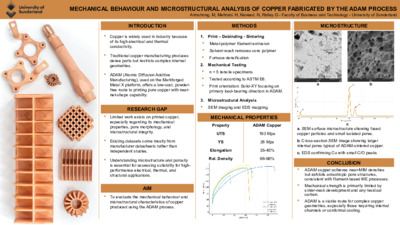 Preview |
PDF (MECHANICAL BEHAVIOUR AND MICROSTRUCTURAL ANALYSIS OF COPPER FABRICATED BY THE ADAM PROCESS)
ISSMART2025_Poster_Armstrong_Copper_AM.pdf.pdf
Download (689kB)
| Preview
|
More Information
| Uncontrolled Keywords: Additive Manufacturing; Atomic Diffusion Additive Manufacturing; Copper; Mechanical Properties; Microstructure |
| Related URLs: |
| Depositing User:
Mark Armstrong
|
Identifiers
Users with ORCIDS
Catalogue record
| Date Deposited: 08 Dec 2025 15:42 |
| Last Modified: 08 Dec 2025 15:42 |


